AI-Assisted Documentation: Turning Faster Documentation Into Living Organizational Knowledge
By Lean Agile Intelligence Product & Research Team
AI Assisted Documentation helps organizations create, maintain, and improve documentation with less manual effort while keeping organizational knowledge more current, consistent, and useful.
Documentation has a familiar organizational problem.
Everyone agrees it is important.
Few teams consistently have enough time to maintain it.
A feature changes, but the supporting guide does not. A new process is introduced while old instructions remain searchable. Subject-matter experts answer the same questions repeatedly because critical knowledge exists primarily in their heads. Teams copy existing documents to save time, creating additional versions that eventually become outdated. Different authors use different structures, terminology, and levels of detail.
Over time, employees learn an unfortunate lesson:
Finding documentation does not necessarily mean finding the truth.
That problem becomes even more consequential as organizations adopt AI.
DORA's research connects documentation quality with organizational performance and the implementation of technical practices. Its AI guidance also emphasizes the importance of accurate, accessible internal information because AI systems depend on organizational context to provide useful answers and support work.
Documentation is therefore no longer useful only to people.
Increasingly, it is part of the organizational context AI depends on to provide useful answers and perform work.
AI also provides a new way to address the documentation problem itself.
Today's tools help generate project documentation, explain existing code, create README files, document APIs, summarize source information, and synchronize documentation with changes in the underlying system.
But generating documents faster does not automatically create better documentation. This is another example of the AI Productivity Paradox: producing more work faster does not automatically improve the performance of the surrounding organization.
Organizations don't simply need AI writing more documents. They need an intentional capability for AI-Assisted Documentation.
That requires moving beyond adding AI writing tools and building the organizational capabilities needed to change how knowledge is created, maintained, and used.
What Is AI-Assisted Documentation?
AI-Assisted Documentation is the use of AI to better enable the creation, maintenance, validation, and improvement of organizational documentation.
That includes using AI to help:
- Draft new documentation
- Summarize complex source information
- Convert existing information into documentation
- Apply consistent structures and formatting
- Improve tone and clarity
- Expand incomplete documentation
- Generate documentation from work artifacts
- Update documentation as products or processes change
- Identify documentation gaps
- Reduce dependence on individual subject-matter experts
The maintenance aspect matters as much as creation.
Many organizations do not suffer from a complete absence of documentation.
They suffer from documentation that is:
Created once → Used for a while → Changed around → Forgotten
AI documentation creates the potential for something more dynamic:
Work changes → Documentation is generated or updated → Human validates → Knowledge remains current
GitHub's Copilot capabilities illustrate this direction through workflows for documenting legacy code, explaining complex logic, creating repository documentation, generating API documentation, and synchronizing documentation with code changes.
The enterprise opportunity extends well beyond software documentation.
The same principle applies to:
- Operating procedures
- Product documentation
- Technical architecture
- User guides
- Training material
- Process documentation
- Knowledge articles
- Policy explanations
- Implementation guides
- Internal FAQs
A stronger AI-Assisted Documentation capability helps organizations answer questions such as:
- Which documentation should AI help create?
- What source information should documentation be grounded in?
- How do we ensure common structure and terminology?
- Which documentation requires subject-matter expert review?
- Can documentation be generated from work that already exists?
- Can documentation be updated when the underlying product or process changes?
- How do we identify stale or duplicated documentation?
- Are employees finding what they need without repeatedly asking SMEs?
- Is documentation creation getting faster?
- Are documentation-related clarification requests decreasing?
- Is internal documentation providing useful context to AI systems?
The objective is not to generate the largest possible knowledge base.
It is to create useful, current, trustworthy documentation with less unnecessary effort.
Figure Out Where You Are
Before improving AI-Assisted Documentation, identify how documentation is currently created, maintained, validated, and connected to the work it describes.
LAI's AI-Assisted Documentation Maturity Model uses five stages to describe that progression.
Organizations still evaluating whether the foundational conditions for effective enterprise AI are in place can begin with an AI Readiness Assessment.
|
Stage |
Where You Are |
Primary Focus |
|---|---|---|
|
Documentation is created and maintained manually, with inconsistent structures and significant dependence on subject-matter experts. |
Use AI to create useful drafts from trusted existing information. |
|
|
Individuals independently use AI to create or improve documentation, but practices and quality vary. |
Learn which AI documentation approaches consistently produce useful output. |
|
|
Teams establish shared structures, prompts, terminology, tools, and review expectations. |
Make AI-assisted documentation more consistent and trustworthy. |
|
|
Documentation creation and maintenance are embedded directly into the workflows that create organizational change. |
Keep documentation synchronized with products, processes, and systems. |
|
|
Documentation continuously improves based on usage, clarification needs, AI context quality, and organizational learning. |
Turn documentation into living organizational knowledge. |
The objective is not to automate every document.
It is to understand where AI Assisted Documentation is today, where documentation creates friction or risk, and what capability should improve next.
The AI-Assisted Documentation Maturity Model
LAI's AI-Assisted Documentation Maturity Model describes how organizations progress from manually authored documents toward living organizational knowledge that is created, maintained, and improved as part of the work.
The five stages are:
Starting → Emerging → Enabling → Operationalizing → Optimizing
The progression is not about generating more content.
It is about changing the relationship between work and knowledge.
At first, AI helps individuals create documentation faster.
Teams then identify which practices produce useful and trustworthy results.
Shared standards create greater consistency.
An integrated AI workflow connects documentation directly to the events and source information that should create or update it.
Finally, usage, questions, organizational change, and AI context needs continuously improve the knowledge system itself.

Starting: Documentation Is Manual, Inconsistent, and Difficult to Maintain
At the Starting stage, AI-Assisted Documentation is absent or rarely used.
Employees manually create documentation. A subject-matter expert writes a guide because nobody else knows the topic well enough.
Another employee creates a separate version because the original cannot be found.
Teams use different formats and terminology. Documentation becomes outdated as the product or process changes.
The organization can have plenty of documents. That does not necessarily mean it has useful organizational knowledge.
What This Looks Like
Common signals include:
- Documentation written manually
- Inconsistent tone and formatting
- Outdated or duplicated content
- Heavy reliance on SMEs for creation
- Knowledge distributed across disconnected sources
- Documentation updated after the fact, if at all
The first opportunity is not to generate every missing document with AI. Giving employees access to AI documentation tools creates potential, but deployment alone does not create impact.
It is to identify high-value documentation that is expensive to create, frequently recreated, difficult to maintain, or dependent on scarce expertise.
How to Progress to Emerging
Start with documentation where trusted source information already exists.
Good early candidates include:
- Existing process notes
- Product requirements
- Architecture information
- Code repositories
- Meeting notes
- Training material
- Frequently answered SME questions
Ask AI to transform those sources into a useful draft rather than asking it to invent documentation from nothing.
The sequence matters:
Source information first. Generation second.
Microsoft's GitHub Copilot guidance demonstrates this pattern by using existing development context to generate code explanations, project documentation, and inline documentation.
Practical Example: Run an AI Documentation Experiment
Choose one document employees regularly need.
For example:
New Developer Service Guide
Currently, a senior engineer repeatedly explains:
- What the service does
- How to run it
- Dependencies
- Configuration
- Common problems
Collect existing sources:
- README
- Code structure
- Architecture diagram
- Existing notes
- Common support questions
Ask AI to create a first draft using this structure:
- Purpose
What does the service do? - Who Uses It
Who depends on it? - How It Works
High-level explanation. - Dependencies
What does it rely on? - Setup
How do you get started? - Common Problems
What frequently goes wrong? - Escalation
Where should someone go for help?
Then have the SME review the draft.
Track:
Traditional creation time
versus:
AI-assisted creation + SME review time
Also capture:
- Material errors
- Missing information
- Unnecessary content
- Amount of editing required
The goal at Starting is not:
AI writes documentation without people.
It is:
AI creates a useful starting point from existing knowledge so SMEs spend more time validating and less time authoring from scratch.

Emerging: Individuals Begin Creating Documentation With AI
At the Emerging stage, individuals independently use AI to create, summarize, restructure, or improve documentation.
A developer generates a README. A product manager asks AI to summarize a feature. An analyst creates an AI-assisted process description.
Employees develop personal documentation prompts. AI-generated text appears inside documentation artifacts.
This experimentation improves individual productivity.
But quality still depends heavily on the individual.
One employee gives AI rich source context and a clear documentation structure.
Another simply asks:
Write documentation for this.
The resulting quality differs significantly.
What This Looks Like
Observable signals include:
- Ad hoc AI-generated documentation drafts
- One-off AI content summaries
- Documentation containing AI-generated content
- Personal documentation prompts
- Different AI documentation approaches across teams
- Inconsistent source grounding and review
The organization now has AI documentation activity.
It does not yet have a shared AI documentation practice.
How to Progress to Enabling
Capture the approaches that consistently produce useful output.
Ask experienced AI users:
- Which documentation types work well?
- What context produces the strongest draft?
- Which structures are effective?
- Where does AI invent information?
- What terminology should it follow?
- How much human review is required?
- Which documents should never be created without SME validation?
- Where should existing information be reused instead of rewritten?
Reusable prompts and instructions become increasingly valuable here.
GitHub allows organizations and repositories to provide custom instructions that shape Copilot responses consistently, while reusable prompts support repeated documentation activities.
The same organizational principle applies beyond technical documentation:
Don't make every employee reinvent how good documentation should be generated.
Practical Example: Run an AI Documentation Practice Harvest
For one month, ask employees to submit AI-assisted documentation examples that worked well.
Capture:
- Documentation Type
Process / technical / product / training / FAQ / other - Source Information
What did AI work from? - Prompt
What did the employee ask AI to do? - Structure
How was the output organized? - What Worked
What saved time or improved clarity? - What Needed Editing
What did AI get wrong? - Review
Who validated the documentation?
You might identify reusable patterns such as:
Explain Existing Material
Turn the supplied technical information into documentation for a new team member. Do not add capabilities or behavior not supported by the source.
Process Documentation
Convert these process notes into: Purpose → Trigger → Steps → Decision Points → Exceptions → Owner.
FAQ Creation
Review these support questions and create an FAQ organized by recurring topic. Consolidate duplicates without removing materially different answers.
Documentation Review
Identify unclear terminology, duplicated sections, missing prerequisites, and statements that appear unsupported by the supplied sources.
Publish the strongest patterns in a shared location.
The goal is to move from:
"I use AI to write documentation."
to:
"We're learning which AI documentation practices consistently improve the work."

Enabling: Shared AI Documentation Practices Become Repeatable
At the Enabling stage, AI-Assisted Documentation becomes a shared organizational capability supported by common standards and practices.
Prompt templates are centralized. Shared AI documentation tools are available. Common documentation structures are established. Tone and terminology become more consistent. Review expectations are explicit.
The organization is no longer relying entirely on the writing ability, prompting skill, or personal preferences of each author.
What This Looks Like
Evidence includes:
- Centralized documentation prompt templates
- Shared AI documentation tools
- Standard document structures
- Common terminology
- More consistent tone and clarity
- Defined source-grounding expectations
- Explicit human review and ownership
The major shift is from:
AI-generated content
to:
AI-generated content operating within organizational documentation standards
How to Progress to Operationalizing
Define what good documentation looks like before automating more of it.
A useful documentation standard should define:
- Audience: Who is this document for?
- Purpose: What should the reader understand or accomplish?
- Source of Truth: What information should AI use?
- Structure: Which sections should appear?
- Terminology: Which language should be used consistently?
- Review: Who owns accuracy?
- Maintenance: What event should trigger an update?
This creates a documentation system rather than a collection of prompts.
DORA's documentation guidance emphasizes accurate, well-organized, user-centric internal documentation. AI should reinforce those characteristics rather than simply increase production volume.
Practical Example: Create an AI Documentation Playbook
Define standard documentation types.
Process Guide
- Audience: Employee performing the process
- Structure:
- Purpose
- Trigger
- Prerequisites
- Steps
- Decision points
- Exceptions
- Owner
- Related resources
- AI Role:
- Organize source information
- Draft explanations
- Standardize formatting
- Human Role:
- Validate the process
- Confirm exceptions
- Approve final version
Product Feature Guide
- Audience: User or internal enablement team
- Structure:
- What it does
- Why it matters
- Who should use it
- How to use it
- Examples
- Limitations
- Troubleshooting
Technical Service Guide
- Audience: Engineers
- Structure:
- Purpose
- Architecture
- Dependencies
- Setup
- Configuration
- Operational behavior
- Troubleshooting
- Ownership
Then create shared AI instructions:
Use approved terminology from the organizational glossary. Follow the specified document structure. Do not invent missing information. Mark unsupported sections as Information Needed. Write for the defined audience and avoid unnecessary detail.
The underlying principle is straightforward:
Consistent context creates more consistent documentation.

Operationalizing: Documentation Becomes Part of the Workflow That Produces the Change
At the Operationalizing stage, AI-Assisted Documentation becomes embedded within the workflows that create changes to products, processes, systems, and organizational knowledge.
Documentation is no longer a separate activity someone remembers to perform after the work is finished.
The standard workflow includes documentation steps. A release triggers documentation work. Backlog items provide source context. Existing documents are evaluated and updated when the underlying work changes.
Documentation creation and update lag become measurable.
What This Looks Like
Observable evidence includes:
- Releases containing AI documentation steps
- Documentation generated from backlog items or work artifacts
- AI-assisted updates to existing documentation
- Documentation impact checks built into workflows
- Improving documentation-creation time
- Reduced lag between a change and its documentation
At Enabling:
- People know how to use AI to create consistent documentation.
At Operationalizing:
- The workflow itself expects documentation to be created or updated when the underlying work changes.
This addresses one of the oldest documentation problems:
- The work changes before the documentation does.
GitHub documents workflows for synchronizing documentation with code changes, illustrating how AI identifies documentation that needs attention when implementation changes.
How to Progress to Optimizing
Identify the events that should trigger documentation activity.
For example:
- Feature Released → User documentation updated
- API Changed → API documentation updated
- Process Modified → Process guide updated
- Architecture Decision Made → Architecture documentation updated
- Support Pattern Emerges → FAQ expanded
The strongest AI workflow connects documentation to the same source artifacts producing the change.
Practical Example: Build a Backlog-to-Documentation Workflow
Consider a product feature.
Step 1: Work Begins
The backlog item contains:
- User problem
- Feature description
- Acceptance criteria
- Relevant design decisions
Step 2: Feature Reaches Release-Ready State
A documentation step is triggered.
Step 3: AI Collects Source Context
Use:
- Backlog item
- Acceptance criteria
- Relevant pull requests
- Product decisions
- Existing documentation
Step 4: AI Determines Documentation Impact
Ask:
Does this change require:
- New documentation?
- An update to existing documentation?
- A new FAQ?
- A release note?
- A training update?
Step 5: AI Produces Draft Changes
For example:
- Existing Feature Guide
- AI identifies outdated sections and proposes replacements.
- Release Note
- AI produces a concise explanation of the change and user impact.
- FAQ
- AI identifies likely recurring questions.
Step 6: Human Review
The product or technical owner confirms:
- Accuracy
- Completeness
- Audience fit
- Terminology
Step 7: Publish
Documentation ships with the change.
This changes documentation from:
Work completed → Someone eventually remembers documentation
to:
Work changed → Documentation workflow responds
Measure the Workflow
At Operationalizing, begin tracking:
- Documentation Creation Time: How long does a usable document take to create?
- Documentation Update Lag: How long between a product or process change and documentation becoming current?
- AI Draft Acceptance Rate: How often is the AI draft usable with only minor changes?
- Major Revision Rate: How often does generated content require substantial rewriting?
- Documentation Coverage: Do important changes have corresponding documentation?
The objective is not simply more documentation.
It is documentation that stays synchronized with the work it describes.

Optimizing: Documentation Becomes a Continuously Improving Knowledge System
At the Optimizing stage, AI-Assisted Documentation becomes a continuously improving knowledge capability informed by how employees and AI systems actually use organizational information.
Teams review AI's impact on documentation workflows. The context supplied to AI becomes richer. Duplicate and stale content is identified. Documentation practices evolve.
Organizations examine whether better documentation corresponds with fewer repeated questions and greater access to trustworthy knowledge.
The ultimate test of good documentation is not:
Did we publish the document?
It is:
Can the intended audience successfully understand or accomplish what they need without unnecessary additional help?
What This Looks Like
Observable signals include:
- Reviews of AI's impact on documentation workflows
- Intentional adoption of new AI documentation capabilities
- Context-enrichment improvements
- Stale and duplicated knowledge actively addressed
- Documentation usage informing improvements
- Trends in clarification requests reviewed
- AI failures used to identify documentation gaps
The question evolves from:
"How quickly can AI create documentation?"
to:
"Is our AI-assisted documentation making organizational knowledge easier to find, trust, and use?"
How to Sustain and Continuously Improve
Create a documentation learning loop:
Create → Publish → Use → Observe Questions → Improve Context → Update Documentation
Pay attention to what happens after documentation is released.
Look at:
- Support questions
- Developer questions
- Product clarification requests
- Search behavior
- Documentation feedback
- Onboarding questions
- Repeated SME interruptions
Every repeated question is potential evidence of a documentation gap.
Practical Example: Run a Quarterly AI Documentation Effectiveness Review
Select the highest-value documentation areas.
For example:
- Product documentation
- Developer documentation
- Process guides
- Onboarding material
Review five dimensions.
1. Documentation Performance
Track:
- Creation time
- Update lag
- AI draft acceptance
- Major rewrite rate
2. Freshness
Ask:
- Which pages have not been reviewed recently?
- Which describe systems that have changed?
- Which contain outdated screenshots or workflows?
- Which contradict other documentation?
AI assists by comparing documentation with current source information.
3. Duplication
Identify documents covering essentially the same topic.
Ask:
Should these remain separate, or should the organization establish one authoritative source?
AI should not make duplicated knowledge easier to create.
It should help identify and reduce it.
4. Clarification Demand
Track questions that occur after people consume the documentation.
For a new feature, that includes:
- Support tickets asking how it works
- Developer questions
- Customer success clarification requests
- Internal enablement questions
For example:
- Before documentation improvement
- 34 clarification requests per month
- After documentation improvement
- 17 clarification requests per month
That trend provides useful evidence.
Do not assume documentation alone caused the change.
Investigate whether documentation improvements contributed.
5. AI Context Quality
This dimension becomes increasingly important as AI systems use internal documentation as context.
DORA's AI-accessible internal data guidance emphasizes that AI cannot reliably use information that does not exist—or information that is inaccurate—and recommends prioritizing high-quality internal documentation.
Review whether documentation provides sufficient context for both people and AI.
For example, a service page might explain:
What the service does
but omit:
- Ownership
- Dependencies
- Operational constraints
- Known failure modes
- Decision history
Those missing elements make the document less useful to both engineers and AI assistants.
Create an AI Documentation Improvement Backlog
|
Improvement |
Reason |
Measure |
|---|---|---|
|
Add glossary context |
AI terminology is inconsistent |
Major edit rate |
|
Connect release metadata |
Documentation becomes outdated after releases |
Update lag |
|
Consolidate duplicate guides |
Employees find conflicting answers |
Clarification requests |
|
Add persona-specific structures |
Content is too generic |
User feedback |
|
Capture recurring support questions |
Documentation misses common confusion |
Support volume |
|
Improve source grounding |
AI generates unsupported detail |
Accuracy corrections |
Then classify improvements:
Keep → Refine → Automate → Consolidate → Retire
Good documentation management includes removing information that should no longer be trusted.
Use AI as a Sensor for Documentation Quality
As internal AI becomes more widely used, another useful signal emerges:
What questions does AI struggle to answer because the underlying organizational knowledge is incomplete?
Suppose employees repeatedly ask an enterprise AI assistant:
Who owns this service?
and the model cannot answer consistently.
That is not necessarily an AI problem.
It might reveal that ownership information is absent, outdated, or inconsistent across the organization's documentation.
AI therefore becomes not only a documentation generator but also a sensor for documentation quality.
Key Takeaway
AI-Assisted Documentation maturity isn't achieved when AI generates documents faster. It is demonstrated when documentation is created and maintained as part of the work, remains useful and trustworthy as the organization changes, reduces unnecessary clarification, and continuously improves based on how people and AI actually use organizational knowledge.
From AI Documentation Generation to Living Organizational Knowledge
AI Assisted Documentation becomes operationalized when individual AI drafting evolves into a shared AI workflow for creating, maintaining, validating, and continuously improving organizational knowledge.
The capability often begins with:
"Write documentation for this."
That saves time.
But operationalization goes much further.
The maturity model progresses from:
Manual Documentation → Individual AI Drafting → Shared Documentation Practices → Workflow-Embedded Documentation → Continuous Knowledge Improvement
Initially, AI reduces the effort required to create first drafts. Individual experimentation reveals where AI contributes most. Shared standards make structure, terminology, grounding, and quality more consistent.
Workflow integration keeps documentation connected to the products, systems, and processes it describes.
Usage, clarification requests, organizational change, and AI behavior then improve the documentation system itself.
That is the difference between using AI to write documentation and operationalizing AI-Assisted Documentation. This reflects the broader difference between AI adoption and AI operationalization: individual use creates activity, while operationalization embeds AI into repeatable workflows, measurement, governance, and continuous improvement.
This capability also creates an important reinforcing effect. High-quality documentation does not only help people work. It creates better organizational context for AI.
That creates a loop:
Better Documentation → Better AI Context → Better AI Assistance → Better Documentation
The opposite is equally important:
Outdated Documentation → Poor AI Context → Poor AI Answers → Lower Trust
As organizations increasingly rely on AI to retrieve and use internal knowledge, documentation quality becomes part of the AI operating model.
The objective is therefore not to build the largest knowledge repository.
It is to create living organizational knowledge that stays current enough to support decisions, work, onboarding, and AI-enabled workflows.
Evaluate the Quality of Your AI-Enabled Knowledge System
Generating documentation faster is only the first step.
The more important question is whether organizational knowledge stays current, trustworthy, accessible, and connected to the work that changes it.
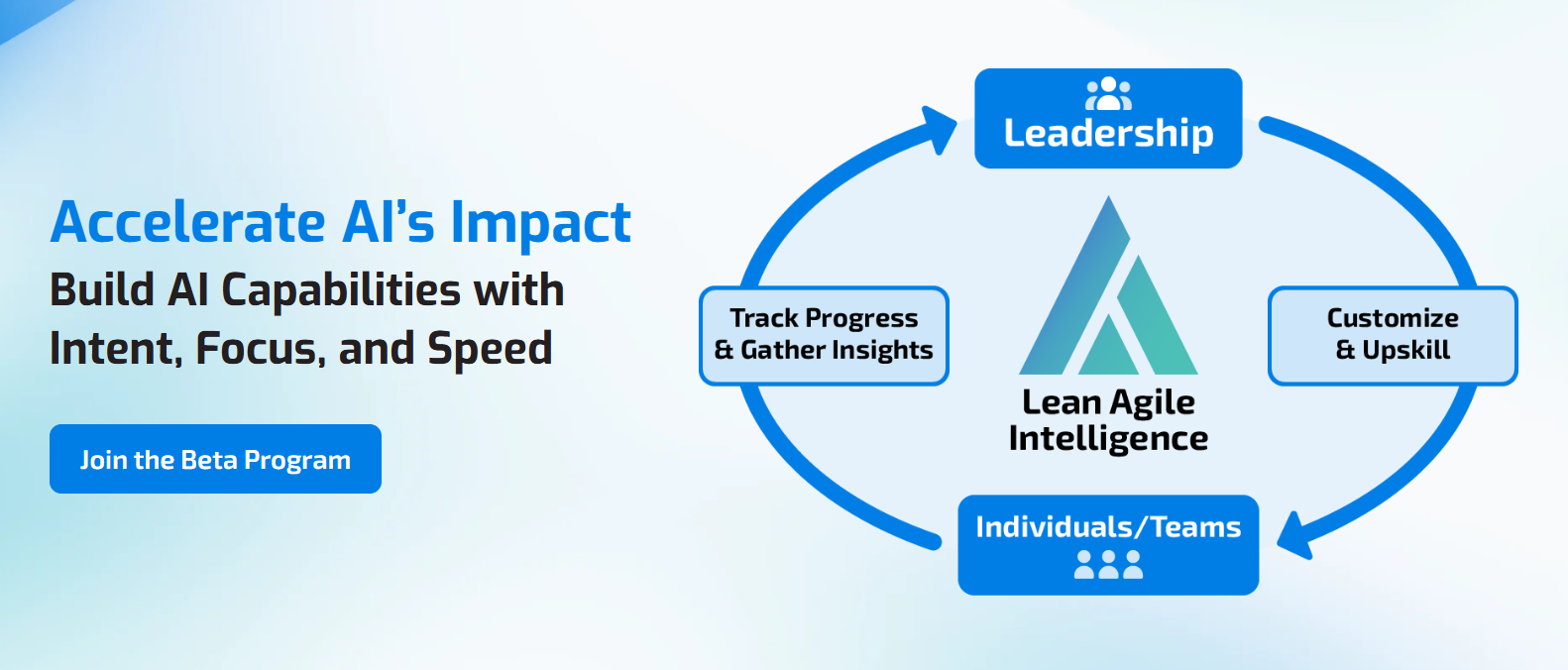
Lean Agile Intelligence helps organizations establish a baseline across AI capabilities and identify whether practices remain dependent on individuals, have become shared across teams, or are embedded into the organization's standard workflows.
For AI-Assisted Documentation, that means examining whether teams have developed shared AI documentation practices, integrated AI workflows, stronger source grounding, faster maintenance, more current organizational knowledge, and feedback loops that improve documentation based on how people and AI actually use it.